Which Way Forward? Balancing Digital Innovation, Scaling, and Technology Sovereignty for Water Security and Agro-Pastoral Livelihoods
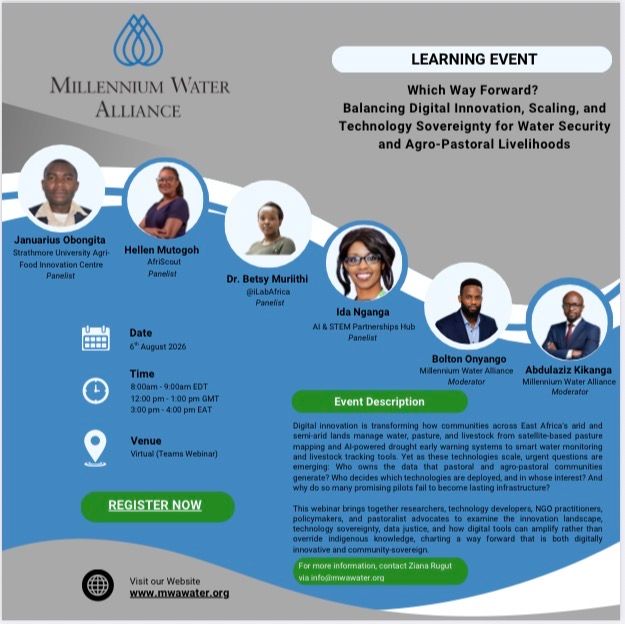
Digital innovation is transforming how communities across East Africa's arid and semi-arid lands manage water, pasture, and livestock, from satellite-based pasture mapping and AI-powered drought early warning systems to smart water monitoring and livestock tracking tools.
Yet as these technologies scale, urgent questions are emerging: Who owns the data that pastoral and agro-pastoral communities generate? Who decides which technologies are deployed, and in whose interest? And why do so many promising pilots fail to become lasting infrastructure?
Hosted by the Millennium Water Alliance, this 60-minute webinar uses pastoral and agro-pastoral livelihoods and water security as a concrete lens to explore the wider tensions between digital innovation, responsible scaling, and technology sovereignty, playing out across health, finance, agriculture, and public services throughout the continent. The session brings together researchers, technology developers, NGO practitioners, policymakers, and pastoralist and agro-pastoralist advocates to chart a way forward that is both digitally innovative and community-sovereign. The webinar aims to:
- Surface and critically examine the current landscape of digital innovations applied to water security and pastoral and agro-pastoral livelihoods, including their demonstrated impact and limitations.
- Explore the concept of technology sovereignty and what it means for communities to own, govern, and benefit from the data and digital systems that shape their lives.
- Interrogate the barriers to scaling promising digital innovations, including financing gaps, policy fragmentation, infrastructure deficits, and the risk of excluding the communities these tools are meant to serve.
- Identify actionable pathways and policy recommendations that centers community agency while enabling responsible innovation at scale.
- Foster cross-sectoral dialogue bridging technologists, practitioners, researchers, and policy actors.
